NEET PG 2026 Exam Pattern and Marking Scheme, Explained
Reflex · 27 Jul 2026 · 5 min read
Last updated: 23 Sept 2026
On this page
NBEMS revised the NEET PG pattern for 2026, and the changes go beyond a smaller question count — they change how you should pace every section on exam day. Here’s the exact structure, the marking math worked out with real numbers, and exactly what’s different from previous cycles.
The Exam at a Glance
| Particular | Detail |
|---|---|
| Conducting body | National Board of Examinations in Medical Sciences (NBEMS) |
| Mode | Computer-based test (CBT), English only |
| Total questions | 180 MCQs |
| Total marks | 720 |
| Duration | 3 hours 30 minutes (210 minutes) |
| Sections | 5 (Group A–E), 36 questions each |
| Time per section | 42 minutes, locked |
| Time per question | ~70 seconds (42 min ÷ 36 questions) |
| Shift | Single shift, 9:00 AM–12:30 PM |
| Exam date | August 30, 2026 |
| Eligibility | MBBS degree + completed compulsory rotating internship |
What Changed for 2026 — Old Pattern vs New Pattern
| Earlier cycles | NEET PG 2026 | |
|---|---|---|
| Questions | 200 | 180 |
| Total marks | 800 | 720 |
| Shifts | Two shifts (some cycles) | Single shift |
| Section review | Broader review scope in some formats | Locked to current section only |
| Marking scheme | +4 / −1 | +4 / −1 (unchanged) |
| Duration | 210 minutes | 210 minutes (unchanged) |
NBEMS hasn’t officially explained the reduction from 200 to 180 questions, but the practical effect is a little more time per question — useful if the paper leans further into clinical vignette–style questions rather than one-line recall.
How the Marking Scheme Works — With Real Numbers
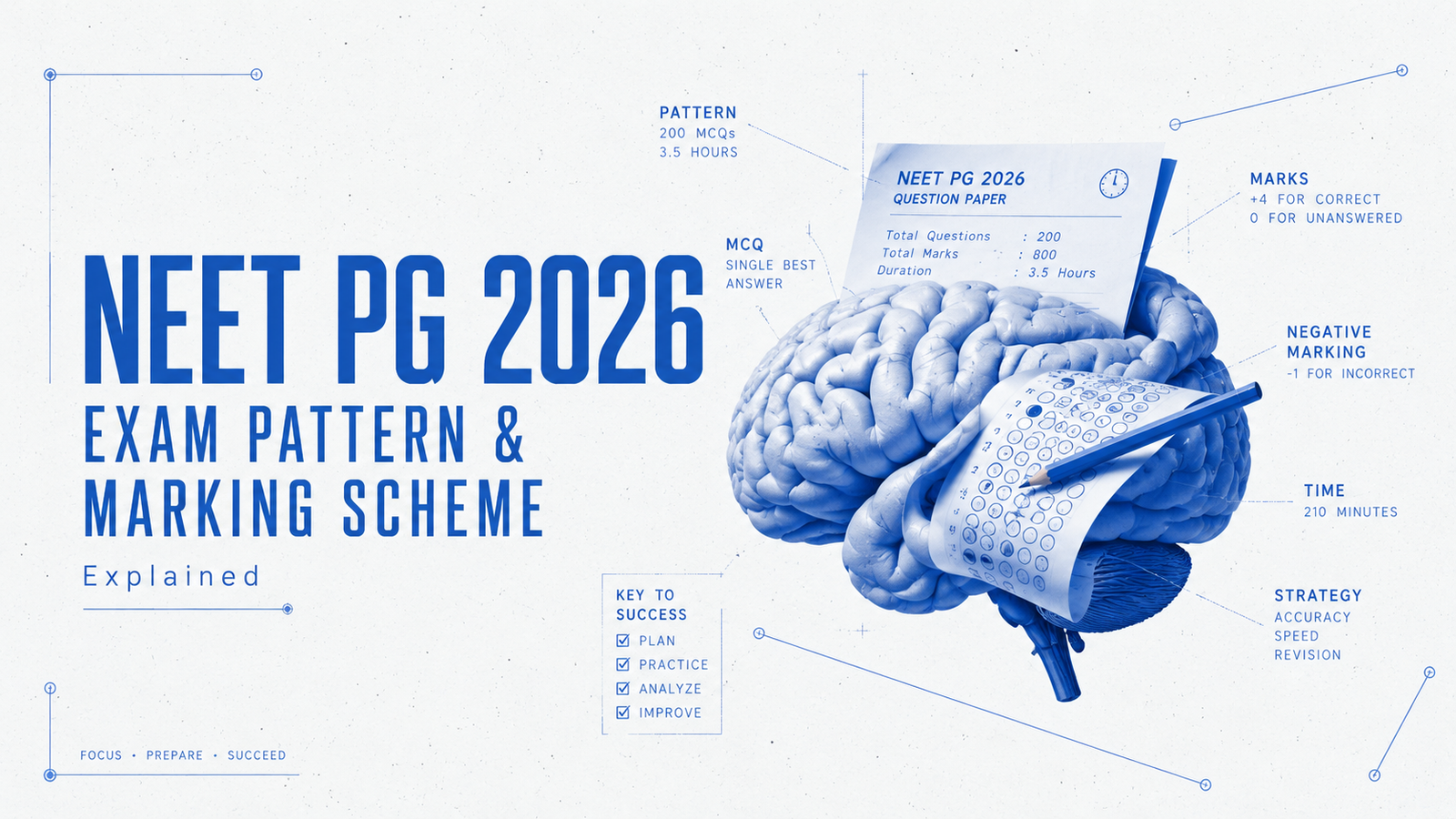
Every correct answer earns +4 marks. Every incorrect answer costs −1 mark. An unanswered question costs nothing.
Here’s what that looks like in practice. Say you attempt 150 of the 180 questions, get 110 right and 40 wrong, and leave 30 blank:
- Correct: 110 × 4 = +440
- Incorrect: 40 × −1 = −40
- Unattempted: 30 × 0 = 0
- Total: 400 out of 720
That gap between "questions attempted" and "score" is where a lot of students misjudge their own performance right after the exam — attempting more questions doesn’t help if accuracy drops. If you would rather not do that arithmetic by hand, the free NEET PG score calculator runs the same +4/−1 maths across all five sections.
Should You Guess?
The asymmetry in the marking scheme changes how you should handle uncertain questions. If you can eliminate even one of the four options, guessing among the remaining three has positive expected value:
- Random guess among 4 options: (1/4 × 4) + (3/4 × −1) = +0.25 marks, on average
- Guess among 3 options after eliminating one: (1/3 × 4) + (2/3 × −1) = +0.67 marks, on average
Both are positive. The only case where skipping is clearly the better move is when you have zero information and can’t eliminate anything — there, a blank costs you 0, not −1, and there’s no expected-value edge from guessing blind on a question you genuinely can’t narrow down.
Section-Wise Structure and Why It Changes Your Strategy
The paper is split into five groups — A, B, C, D, and E — each with exactly 36 questions and a fixed 42-minute window. Section C typically carries close to half the total marks, weighted toward the major clinical subjects.
"Mark for review" still exists, but its scope changed: within a section’s time window, you can flag a question and return to it before that section ends. The moment the section’s 42 minutes are up, the exam auto-advances — you cannot go back, reviewed or not.
This is the single biggest tactical shift in the new pattern. You’re no longer managing one 210-minute clock — you’re managing five independent 42-minute clocks. Running long on Section A doesn’t just cost you time; it costs you Section A specifically, and you carry no time surplus into Section B. A few practical adjustments follow from this:
- Triage within each section first. In the opening minute or two, skim for questions you can answer instantly and lock those in before spending time on harder ones.
- Don’t let one hard question eat a section. At roughly 70 seconds per question, a single 4-minute struggle on one MCQ is nearly six questions’ worth of time gone.
- Practice sectional mocks, not just full-length ones. A 210-minute mock doesn’t train the actual constraint you’ll face, which is five separate 42-minute sprints.
Subject Weightage at a Glance
Marks aren’t distributed evenly across subjects. Based on consistent patterns across recent cycles:
| Weightage tier | Subjects |
|---|---|
| High | General Medicine (incl. Dermatology, Psychiatry), General Surgery |
| Moderate | Pathology, Pharmacology, Obstetrics & Gynaecology, Pediatrics |
| Lower | Forensic Medicine, ENT, Ophthalmology, Anaesthesia, and other smaller subjects |
Knowing this before you build a study plan changes how you should allocate time — scoring 100% in a subject worth 15 marks while your 150-mark subject sits at 60% is a losing trade. We cover exactly how to allocate study hours around this in our NEET PG study plan guide.
One Thing to Watch: Video-Based Questions
NBEMS has not officially confirmed Video-Based Questions (VBQs) for NEET PG 2026. FMGE has already introduced a similar format, which is why some aspirants are choosing to get familiar with it as a precaution. Treat this as something to watch for in official bulletin updates, not something to build your entire prep around.
Practicing under the actual section-locked format matters more than most students realize. Reflex’s daily TROCAR quizzes run subject-wise and timed, so you’re training the pacing the exam will actually demand — not just the content.
Practise this on Reflex
Turn what you just read into recall with 14 years of tagged PYQs.
FAQ
Frequently asked questions
The questions aspirants ask most about this topic.
180 multiple-choice questions for a total of 720 marks.
+4 for every correct answer, −1 for every incorrect answer, and 0 for unattempted questions.
No. Once a section’s 42-minute window closes, the system automatically moves to the next section and the previous one is locked, including any questions you’d marked for review.
No. Leaving a question blank costs you nothing — the −1 penalty only applies to incorrect answers.
3 hours 30 minutes (210 minutes) total, split into five 42-minute sections.
Stay ahead in your preparation
Get expert tips, exam updates, and high-yield insights delivered straight to your inbox.
No spam. Unsubscribe anytime.
More in Exam Guide
View all → Exam Guide
NEET PG 2026 Result Declared: Cutoff 262/720 & Scorecard
 Exam Guide
INI-CET Registration for January 2027: The Two-Stage Process, Documents, and Mistakes to Avoid
 Exam Guide
Which Institutes Accept INI-CET: AIIMS, PGIMER, JIPMER, NIMHANS & SCTIMST
 Exam Guide